The Five Most Popular Artists of 2025
From our unique vantage point working with more than 375 museums across North America, we are privileged to be able to take in a bird’s-eye view of the institutional collecting landscape, including evolving interests, concerns, and new practices shaping the curatorial field.
As we reviewed the works from last year's catalogues that drew the most interest from our museum community, several common themes emerged as key considerations for museums growing their collections. These ranged from an expansion in the representation of Black, Indigenous, and People of Color (BIPOC) artists to an attention to sociopolitically engaged perspectives. Please join us as we take a look back at our five most popular artists of 2025:
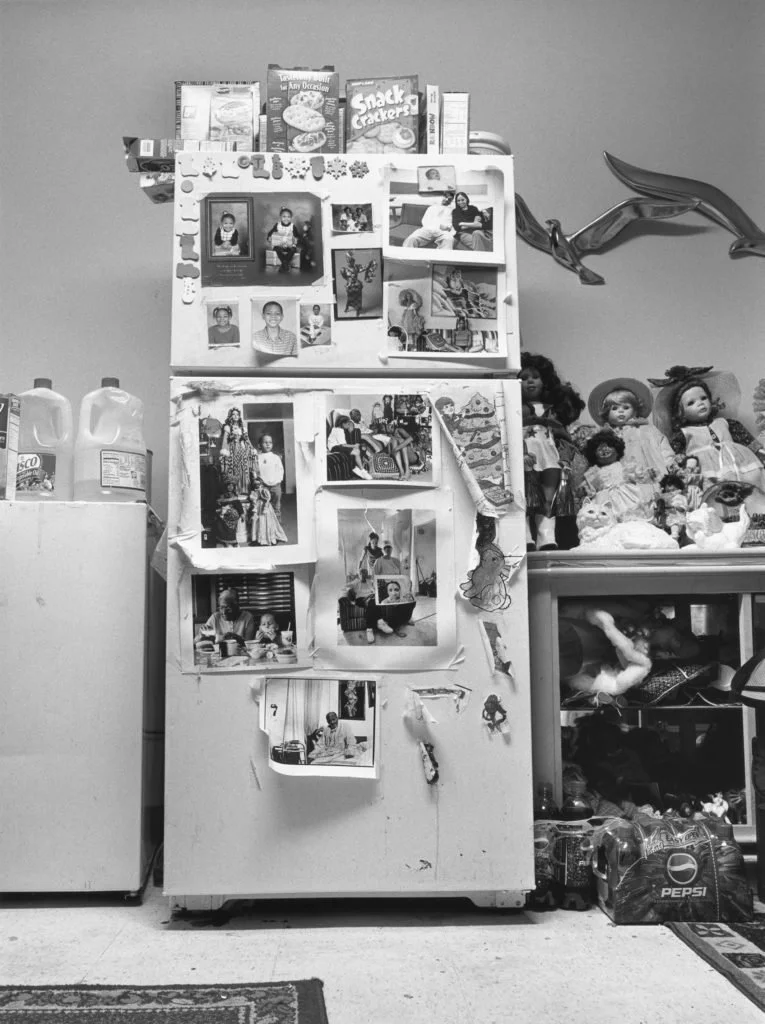
LaToya Ruby Frazier, Grandma Ruby's Refrigerator, 2007, gelatin silver print, edition 4 of 8 + 2APs, 20 x 16 inches. Collection of Addison Gallery of American Art, Andover, MA; Gift from Collection of Marguerite Steed Hoffman.
LaToya Ruby Frazier
The most sought-after work of the year came from LaToya Ruby Frazier (American, b. 1982), the celebrated photography, video, performance, and installation artist known for a body of work that extends lineages of 1930s social documentary and 1960s-70s conceptual photography, emphasizing the social and political issues intertwined with everyday life.
We were fortunate to include in our spring catalogue Grandma Ruby’s Refrigerator (2007) from Frazier’s groundbreaking photographic series "The Notion Of Family" (2001-2014). These seminal photographs show the artist’s hometown of Braddock, Pennsylvania, a former steel town in economic decline, through the lens of her intergenerational household—primarily her grandmother, mother, and herself—and their survival amidst its harsh conditions of environmental racism and disinvestment.
In Grandma Ruby’s Refrigerator (2007), Frazier transforms an otherwise ordinary interior view into a touching portrait of her grandmother, represented by the site of the kitchen so central to the home. The work’s poignancy, social relevance, and significance within both the trajectory of Frazier’s career and the broader art historical canon resonated strongly with our museum members, who were eager to include the 2015 MacArthur Fellowship recipient in their collections.
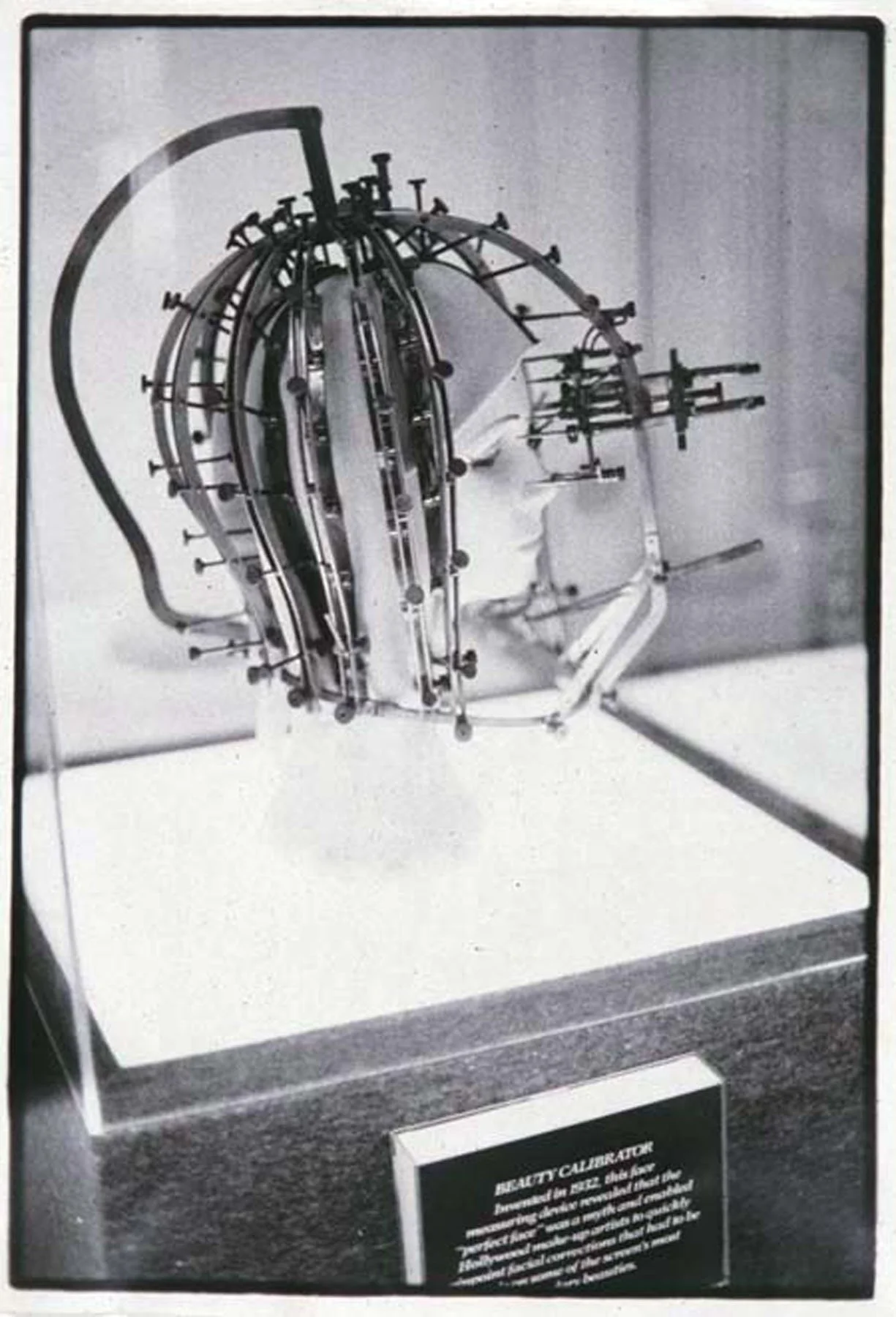
Zoe Leonard, Beauty Calibrator, 1993, gelatin silver print, edition 1 of 6, 24 x 17 inches. Collection of the Institute of Contemporary Art, Boston, MA; Gift of Christopher and Cécile D’Amelio.
Zoe Leonard
The critical feminist perspective of artist Zoe Leonard (American, b. 1961), who is known for work addressing themes ranging from gender and sexuality to migration and displacement, likewise generated significant interest from our museum community.
We were pleased to feature Leonard’s Beauty Calibrator (1993) among our spring offerings. The work is part of a series of related photographs in which the artist examines the instruments imposed on women and their bodies throughout history, calling our attention to the pervasive and enduring patriarchal values that undergird them. Her approach to photographing this bizarre, torturous-looking tool—once displayed in Hollywood’s former Museum of Beauty—is non-documentarian, intentionally dramatizing its disturbing nature and violence.
Our museum members clamored to count Leonard among their collection artists, citing her significant place among her generation of artists exploring identity and the politics of representation through photography.
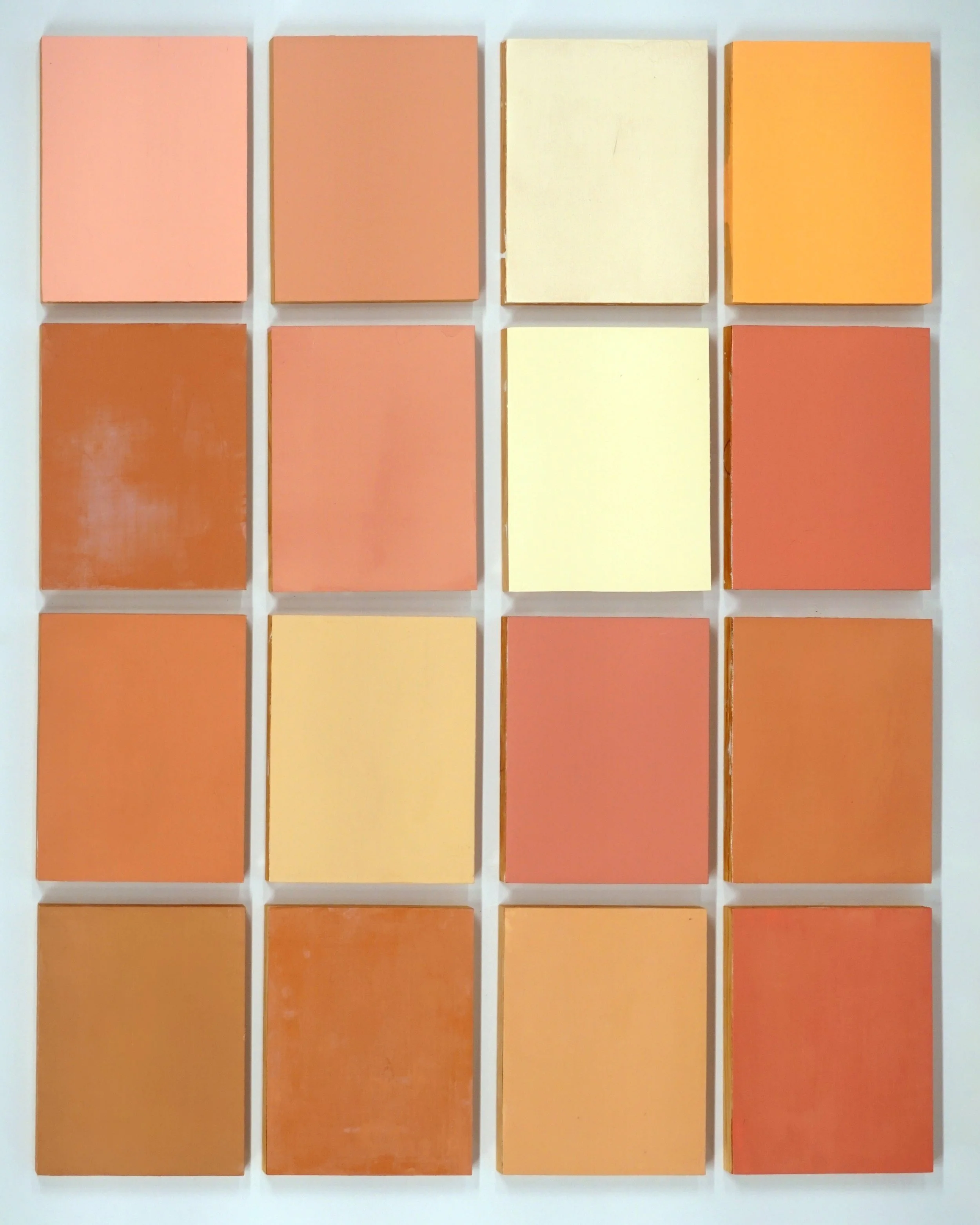
Byron Kim, Flesh, 1992, oil on wood panel, 10 x 8 inches (each).
Byron Kim
Artist Byron Kim (American, b. 1961), most recognized for a conceptual painting practice at the intersections of abstraction and representation, drew a near-instantaneous response from our museum members last fall with a work also exploring identity and representation.
Presenting as a straightforward minimalist painting, Kim’s Flesh (1992) betrays its actual content in its title, as each grid within the composition depicts varying tones of skin color. An icon of the identity politics and multiculturalism that defined its era, the work continues to resonate today with conversations about the intersection of beauty standards and skin color, while operating within the boundaries of high modernist abstraction.
Our museum members saw the infinite potential for Kim’s work to spark discourses about racial identity and visibility at their institutions, simultaneously acknowledging the importance of expanding the representation of BIPOC artists within their collections through the addition of Kim’s crucial perspective.
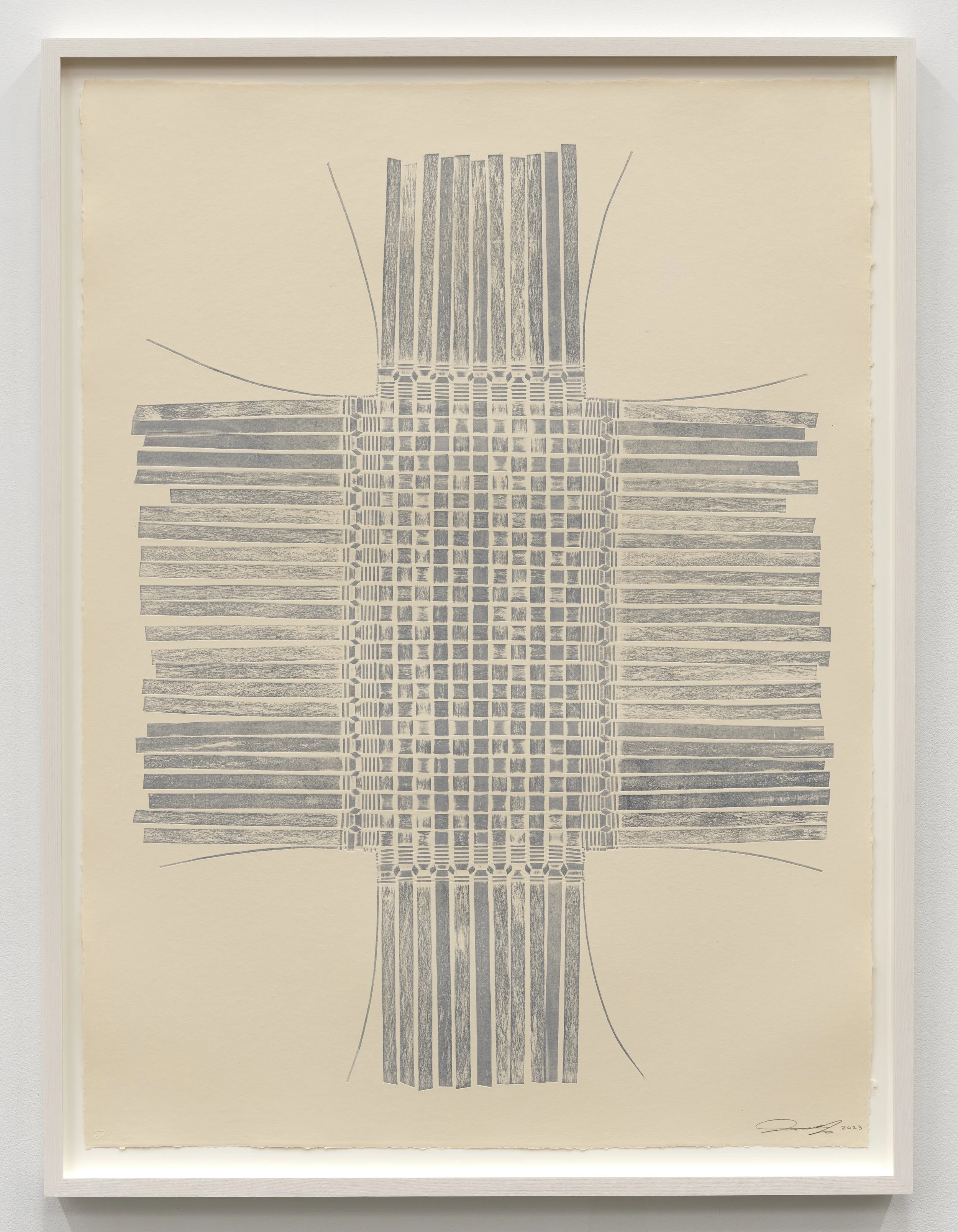
Jeremy Frey, Untitled, 2023, basket relief print, 42 x 30 inches. Collection of Addison Gallery of American Art, Andover, MA; Anonymous Gift.
Jeremy Frey
Another narrative-expanding figure who generated strong engagement from our museum members was Jeremy Frey (American, b. 1978), a Passamaquoddy artist and 2025 MacArthur Fellow renowned for his intricate brown ash and sweetgrass baskets.
Honoring and extending traditional Wabanaki basket-weaving traditions through his introduction of new materials, unique forms, and fine weaves, Frey is known for producing striking works that have drawn wide institutional interest, as evidenced by a recent solo exhibition that has traveled to four museums coast-to-coast. Among his many significant contributions, Frey has challenged gendered roles through his production of a style of "fancy baskets" typically executed by women, and we were thrilled last spring to feature an untitled 2023 relief print capturing the impression of one of these basket forms.
Frey’s work was met with equal enthusiasm by our museum members, who shared their commitment to growing the representation of Indigenous artists within their collections—a direction reflected in the broader museum landscape that can be seen in examples like Crystal Bridges Museum of American Art’s acquisition of ninety contemporary works by Indigenous artists last year.
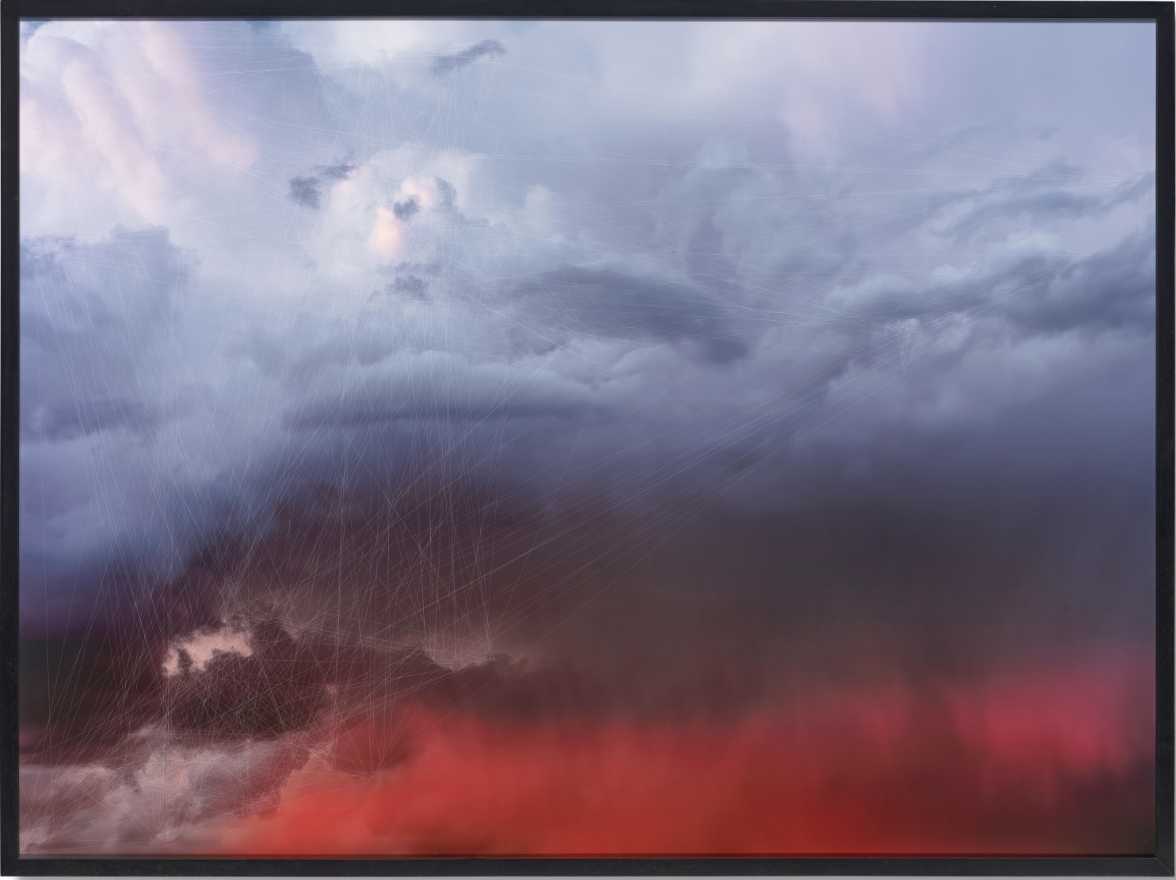
Trevor Paglen, CLOUD #135 Hough Lines, 2019, Dye sublimation print, 48 x 65 inches.
Trevor Paglen
Finally, but no less significantly, our institutions had a resounding response to the work of artist Trevor Paglen (American, b. 1974), a 2017 MacArthur Fellowship recipient, geographer, and author known for his work investigating global state surveillance and data collection—ever-present topics in our contemporary world.
CLOUD #135 Hough Lines (2019) featured in our fall catalogue is part of the artist’s ongoing inquiry into how computer vision systems and artificial intelligence “see” the world. In it, Paglen overlays an image of a cloud formation with lines and strokes that represent how the Hough Transform computer vision algorithm interprets it. The work is at once visually alluring and an ominous reminder of the ubiquitousness of these technologies in our everyday lives. As the artist shares, “We are now living in a world of planetary-scale 'Smart Cities' that track license plates, cell phone signals, faces, and pedestrian movements; self-driving cars autonomously navigate urban environments; robotic factories use computer vision for quality assurance and logistics” (Pace Gallery).
Our museum members were moved by the questions Paglen’s work raises surrounding the unseen implications of technological advancement, and saw the opportunity to spark dialogue among their audiences through its socially relevant and open-ended nature.
We hope that this glimpse of our most popular artists of 2025 gives you a sense of some of the most pressing questions and interest areas driving museum collecting today. We invite you to reach out should you have any works that you think might help fulfill these needs for museums