
How Are Art Museums Funded?
A question we often hear from donors considering which museums to support is how financially healthy the institution is. Answering that requires first understanding how museums in the United States are funded. Unlike in Europe where museums are largely funded by the state, American museums rely on a diversified funding model, drawing on government grants, private philanthropy, corporate sponsorships, membership dues, earned income, and endowment income. Each plays a critical role in supporting museum operations and collections, and is sustained by an enormous, never-ending fundraising effort.
A Uniquely American Model
The reliance on private philanthropy is deeply rooted in the history of American museums. With no royal collections to nationalize and no crown to fund a national gallery, from the very beginning museums relied on the vision and generosity of private citizens rather than monarchs or governments. The Metropolitan Museum of Art in New York, Carnegie Museum of Art in Pittsburgh, Museum of Modern Art in New York, Frick Collection in New York, and National Gallery of Art in Washington, DC all trace their origins to individual donors or civic-minded groups and many still carry their names today. That founding pattern hasn't gone away. It's simply evolved from a handful of Gilded Age fortunes into a broader, more distributed ecosystem.
Government Funding
Public support is one of the most direct ways museums get funding, and though meaningful, it comprises a much more modest share of museum budgets than most people assume. At the federal level, the National Endowment for the Arts (NEA) and Institute of Museum and Library Services (IMLS) are the primary sources of funding, offering annual grants to support everything from collections and conservation initiatives to education programs and community engagement. State and local governments provide additional support through state arts councils, county arts commissions, and city cultural affairs offices; particularly for civic and municipal museums.
Historically, government funding has represented an average of 15% of the operating revenue at art museums plus another 3% coming from colleges and universities, per the Association of Art Museum Directors' 2018 Art Museums by the Numbers report (the source of all figures unless otherwise noted). But that support is increasingly under pressure with changes in government. In the American Alliance of Museums’ 2024 National Snapshot survey, one-third of museums identified reductions or elimination of government funding as an anticipated disruption to their operations. That uncertainty makes the other sources of museum funding all the more important.
Private Philanthropy
Private philanthropy is the backbone of American museum funding. Individual and family contributions and foundation grants represent one of the largest categories of museum revenue, accounting for roughly 18% of the average museum’s budget. An additional 22% on average comes from endowment income, much of which originated as private gifts in earlier years and provides institutions with an ongoing, reliable source of income.
For major museums, a single gift can have a transformative impact. But philanthropy isn't limited to multi-million-dollar donations. Annual giving, foundation grants, planned gifts, and gifts of art all contribute to the financial health of museums. For individual collectors, this presents an opportunity to contribute in whatever magnitude they are comfortable with. Donating a work of art can provide a museum with an acquisition it might otherwise be unable to afford or would have had to purchase, freeing up funds for other priorities.

Craig Kauffman, Untitled, 1972, watercolor on paper, 11 ½ x 16 inches. Buffalo AKG Art Museum, Buffalo, NY; Gift of Anna and Antonio Valverde.
Corporate Sponsorships
Corporations provide another important source of support, with corporate contributions and corporate memberships generating roughly 5% combined of the average art museum's budget. Although a smaller line item than government or private support, corporate giving is often highly visible and funds some of the exhibitions and public programs you're most likely to remember. These partnerships take various forms—an exhibition sponsorship, a membership or access perk such as free admissions on certain days, or a longer-term institutional partnership tied to education programs or conservation initiatives—and can help museums reach new audiences and elevate a museum’s profile.
Memberships and Events
Membership programs sit at the intersection of fundraising and audience development, and they're one of the most straightforward ways a regular museum-goer contributes to an institution's financial health. Beyond free or discounted admission, most programs offer members early access to exhibitions, invitations to exhibitions previews and lectures, and discounts at the museum store and café; all of which build the kind of loyal, recurring base of support that gives a museum's finance team a more predictable revenue picture than one-off ticket sales.
Museums also rely heavily on major fundraising events, including galas, benefit auctions, and patron dinners. These programs cultivate deeper relationships with donors and can generate significant annual support. Together, individual and family membership dues make up a modest but important portion of an average budget at roughly 6% of total revenue, with benefit events contributing another 4%.
Earned Income
Earned income such as the money you spend at the admissions desk or the gift shop is perhaps the source of funding most people associate with museums, but it generally represents a smaller share of their finances than expected. Admissions typically generates only a modest share of the budget. Remuseum’s 2024 Access, Scale & Market Share report found that admission fees account for just 1% to 4% of museum revenue nationally, rising somewhat at institutions with heavy tourist traffic. Museum stores, restaurants and cafés, and facility rentals and events round out the rest of this earned-income category. Many museums now offer their galleries and event spaces for corporate dinners, weddings, and gala fundraisers, which can generate significant single-night revenue while introducing new audiences to the institution. Taken together, earned income makes up about 27% of the average art museum's budget, split roughly across admissions at 7%, retail at 8%, food services at 3%, facility rentals and events at 3%, and other revenue at 6%.
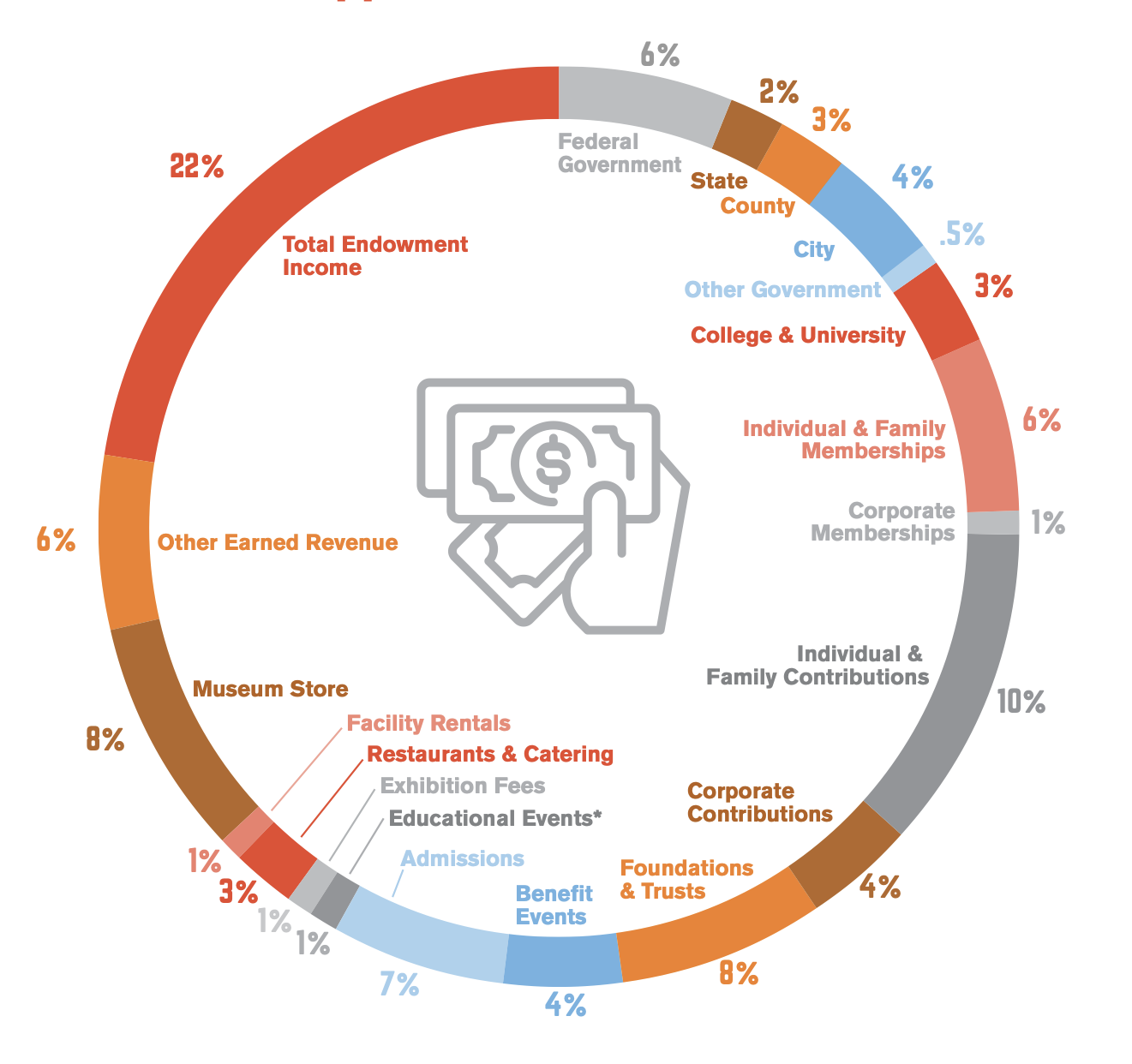
Association of Art Museum Directors, Art Museums By the Numbers 2018, “Average Sources of Revenue & Support,” 2018
The State of Museum Funding Today
Museum funding overall is under significantly more pressure than it was even five years ago, and three trends in particular are reshaping how museums think about their finances.
Government funding is uncertain. 66% of directors surveyed in Ithaka S+R’s 2025 Art Museum Director Survey expect government support to decline over the next five years. As public support becomes less predictable, museums must rely increasingly on corporate partners, private philanthropy, and membership programs.
The cost of operating a museum continues to rise. Caring for collections is becoming increasingly expensive. Storage, conservation, security, insurance, facilities, and staffing all represent significant ongoing costs and every new object added to a collection creates a long-term stewardship obligation.
Museums are reconsidering admission fees. Many institutions have moved toward free admission in an effort to broaden access. 57% of museums in Museum Exchange’s member network offer free admission. The benefits can be substantial, but eliminating ticket revenue requires museums to replace that income through philanthropy or other sources, and creates a challenge for growing membership since free admission is one the primary perks of membership.
These challenges point toward the same conclusion: financially resilient museums are those with diversified sources of support and strong relationships with their donors.
Supporting Museums Through Museum Exchange
Looking at the numbers above, it becomes clear that philanthropy, in one form or another, is the cornerstone of art museum funding in the U.S. But supporting a museum doesn't just mean writing a check. Sometimes the most meaningful contribution is a gift of art. A donated work can fill a specific gap in a museum's collection, advance a scholarly or curatorial initiative, or welcome new visitors who see their stories represented. At the same time, a gift of art can help museums conserve their financial resources for other priorities.
The traditional philanthropic model relies heavily on patrons who live near their chosen museum. Museum Exchange’s national network of collectors and museums breaks open this limitation, connecting donors and recipients based on their shared interests rather than their physical proximity. As a case in point, 93% of the works donated in 2025 went to institutions outside the donor’s home state. For museums, this creates opportunities to access works that would have been unknown to them and therefore unable to acquire. The matchmaking that occurs also introduces museums to new donors, some of whom can go on to support the museum in other ways. For donors, it creates an opportunity to make a meaningful contribution to an institution and ensure that a cherished work can be appreciated by the public for years to come. The relationship between museums and donors of art has always been a sign of a healthy cultural ecosystem in a given city, now those relationships can transcend a single locale and have a national impact.
If you have works that you believe belong in a museum, or would like to explore ways to support an institution you care about, we would welcome the conversation.